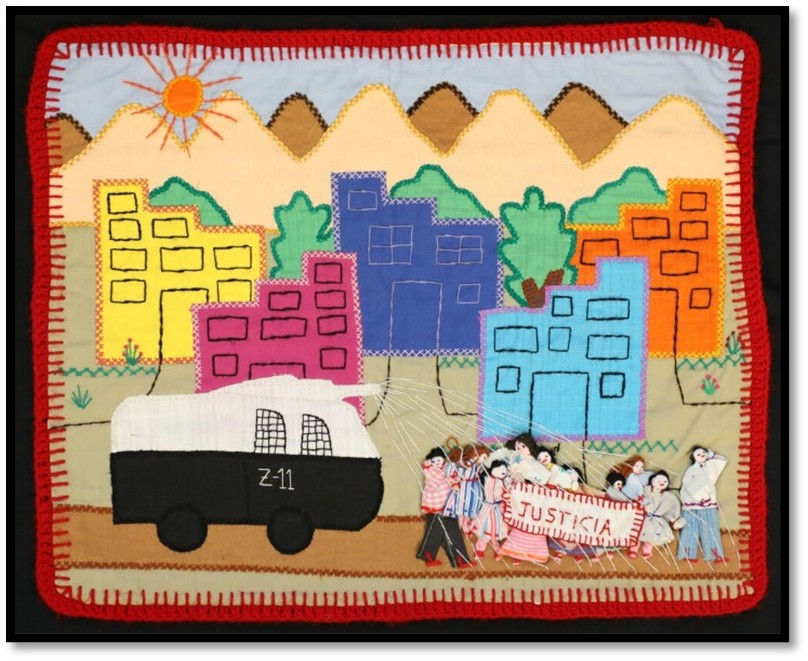
The Archives of Terror: Evidence of Operation Condor and the Search for Justice
Updated: Feb 19

In 1974 Martin Almada was a left-wing teacher in Asuncion Paraguay fighting for better pay and conditions. That work, along with having read a book by Brazilian Marxist educator Paulo Freire made him a target of the secret police who came to arrest him in his classroom. Almada recalls the charge with a laugh, arrested for being both an “intellectual terrorist and ignoramus.”[i] For one month he was brutally tortured in much the same way as detailed earlier in the chapter while his wife was taunted by the police. The police played Almada’s screams over the phone to his wife, their psychological torture drove her to suicide when they lied to her that Almada had died. [ii]

Almada’s ordeal was not over and for three years he was jailed. There he met inmates from other South American countries who revealed that this was a secret operation by Latin American countries co-ordinating together. "I'd heard about Operation Condor when I was in the belly of the condor itself" says Almada.[iii]
Following a hunger strike and a campaign launched by Amnesty International and faith groups Almda was freed and granted asylum in Panama later moving to Paris. He lived fifteen years in exile working for UNESCO until the fall of Stroessner, when he returned to search for documentation to prove of his torture and arrest. In December 1992 he received a tip off by a disgruntled wife of a policeman that led him and judge José Agustín Fernández to a police station on the outskirts of the capital. "This was a completely normal police station," Almada later explained, "In the yard, there was a bakery, some workshops and, at the very back…. a building containing a mountain of papers”.[iii]
The 700,000 pages of documents were the result of secret police chief Pastor Coronel’s obsession with paperwork. It revealed a sprawling network of repression: interrogation transcripts, movements of suspects, opposition meeting transcripts, photos of attendees of weddings and funerals, arrest records, number plates of cars near clandestine meetings and transfers of arrestees between countries. This evidence was crucial for human rights organizations as previously there had only been witness testimony and Almada described the find as
“the taking of the Bastille”. [iv]

In that vast trove of documents Almada found a document marked Top Secret, it was an invitation from Manuel Contreras, head of the Chilean secret police to ally countries attend that fateful 25th November meeting in 1975 where the Southern Cone nations formalized Plan Condor. It was a vital document that allowed historians and human rights organizations to understand the innerworkings of Condor, as one historian put it:
"The Chileans and Argentines would be mad as hell to know that these documents were not disposed of."[v]
These documents led to attempts to prosecute General Pinochet between 1998 to 2006 and has been used for other human rights cases in Argentina and Chile. In Paraguay only a handful of torturers have faced justice, nonetheless Almada feels vindication:
“When I was handcuffed and shackled, I used to say to them that the world was a slowly turning wheel and that sooner or later democracy would come and I would play a very important role…. I made that up, of course, and I doubt they believed me, but in a way it has come true.”[vi]
Arrests and trials: Trial of the Juntas
“It is best to remain silent and to forget. It is the only thing to do: we must forget. And forgetting does not occur by opening cases, putting people in jail.” – Augusto Pinochet, 13 September 1995[vii]

Following the defeat of Argentina in the Falklands war in 1983 the Argentine Military Junta collapsed which created a domino effect of democratisation that swept across the continent.[viii] With the slow return of democracy there have been attempts to find burial sites, maintain museums, and identify perpetrators some who have fled internationally. This has been done through both official channels such as the court system and through human rights organisations and grass roots initiatives.
The first major trials against any perpetrators occurred in Argentina. The 1985 ‘Trial of the Juntas’ saw the trio of top military leaders (Lieutenant General Jorge Rafael Videla representing the Army; Admiral Emilio Massera representing the Navy; and Brigadier General Orlando Ramón Agosti representing the Air Force) convicted of a variety of crimes such as kidnapping, torture and murder. The five top military officials were sentenced to life imprisonment while over 600 more cases were brought to the courts but were obstructed by several laws passed in 1985 and 1986 which effectively ended any more criminal prosecution of the military.[ix]
In 1990 President Carlos Menem pardoned all of those originally sentenced. Finally in 1998 and 2003 faced with mounting pressure the Argentinian Congress repealed the amnesty laws deeming them unconstitutional. Again, a slew of military officials were arrested, Videla re-sentenced in 2010, later Reynaldo Bignone and 14 other military officers were sentenced to life in 2016. Alfredo Astiz and Captain Jorge Acosta, part of the ESMA detention centre and responsible for the death flights were sentenced in 2017 along with 29 others.[x] Despite hundreds of convictions of those complicit in the Dirty War, many have felt that the delay has meant justice denied; Cecilia Devincenti, the daughter of Azucena Villaflor (one of the founders of the Mothers of the Plaza de Mayo) when asked for comment replied:
"I don't believe in justice 34 years after the fact, now that the accused are too old and decrepit for it to matter… My father died of sadness three years after my mother was taken, I think it is more a parody than real justice now."[xi]

International Justice?
In 1999 the Bill Clinton administration declassified 16,000 secret U.S records between Chile and the U.S government which shed light on the knowledge and involvement of the United States government and top officials such as Henry Kissinger. In 2016 the Obama administration began declassification of Argentinian records, and which has continued under the Trump administration, by the end of 2019 over 47,000 documents have been released.[xii]
Much like when DINA chief Manuel Contreras boasted that they would go to Australia if they had to, the international courts have hunted down and found perpetrators across the world and quite literally in Australia (as in the case of Adriana Rivas who is alleged to have worked for DINA and worked in Bondi as a cleaner). [xiii] Argentina was a rare case; Chile did not become a democracy until 1990 and the criminal justice system was slow to prosecute military officials involved in the Dirty War.

In October 1998 a Spanish court indicted Augusto Pinochet for the murder and torture of several hundred Spanish nationals and he was arrested in London a week later while visiting for medical treatment. His arrest led to a lengthy legal battle between British courts and Pinochet, the latter claiming he was entitled immunity as a former head of state- the decision went to the highest court in the UK which ultimately ruled that he was not entitled to immunity though he could only be prosecuted for crimes after 1988 the year in which implemented legislation ratifying the United Nations Convention Against Torture. Despite the ruling, which resulted in 17 months of house arrest, Pinochet was allowed to return to Chile on humanitarian grounds due to ill health by home secretary, Jack Straw (although many criticised his miraculous recovery from a wheelchair-bound patient in London to walking off the tarmac back in Santiago). His later years saw him multiple cases brought against him in Chile, and he was again placed under house arrest in 2004, he died in 2006 with hundreds of charges against him, having never been convicted.
Manuel Contreras bounced in and out of various prisons since 1995 but ultimately was given a life sentence, his jail was Penal Corderilla, a ‘luxury jail’ inside a military compound, complete with an aviary, pools and gardens. [iii]It housed five other top officials convicted, Corderilla was closed in 2013 due to backlash after Contreras gave an interview from the jail.[xiv]

Over 700 cases were held in Chile in the 2000s and there are still more ongoing. In 2019 Italian courts convicted 24 senior officials from various countries one being the former President of Peru, and another the foreign minister of Uruguay, some were convicted in absentia.
In Australia Adriana Rivas is still held in prison, a secretary for DINA in Chile she too was tracked down after providing an interview in 2013 to SBS, she has been in custody since 2019 and is fighting extradition. [xv] Not all countries have pursued convictions, in Brazil there has been no criminal conviction of anyone involved in the military dictatorship and its crimes due to amnesty laws passed in 1979.
[i] Simon Watts. Archive of Terror BBC, Witness History. December 12,2012. https://www.bbc.co.uk/sounds/play/p011lrdw
[ii] The police claimed she had a heart attack.
[iii] Simon Watts. “How Paraguay’s ‘Archive of Terror’ Put Operation Condor in Focus.” BBC News, December 22, 2012. Accessed August 21, 2024. https://www.bbc.com/news/magazine-20774985.
[iv] Ibid
[v] Brian Murphy. Martín Almada, activist who exposed Paraguay’s ‘archive of terror,’ dies at 87. Washington Post, April 5, 2024. https://www.washingtonpost.com/obituaries/2024/04/05/martin-almada-paraguay-activist-dies/
[vi] Simon Watts. How Paraguay’s ‘Archive of Terror’ Put Operation Condor in Focus. BBC News, December 22, 2012, sec. Magazine. https://www.bbc.com/news/magazine-20774985.
[vii] Ibid
[ix] However, Pinochet retained power in Chile until 1990.
[x] Most likely from the threat of a new coup d’etat
[xi] Stauffer, Caroline , Maximiliano Rizzi , and Miguel Lobianco. 2017. “Argentine Court Sentences 29 to Life for Dictatorship Crimes.” Rueters. Rueters. November 30, 2017. https://www.reuters.com/article/idUSKBN1DU0B1/
[xii] Uki Goni. Argentina's 'Angel of Death' Jailed for Life. The Guardian, October 27, 2011, https://www.theguardian.com/world/2011/oct/27/argentinas-angel-of-death-jailed
[xiii] Carlos Osorio and Peter Kornbluh eds. Declassification Diplomacy: Trump Administration Turns Over Massive Collection of Intelligence Records on Human Rights and Argentina. National Security Archive, Apr 12, 2019. Accessed August 22, 2024: https://nsarchive.gwu.edu/briefing-book/southern-cone/2019-04-12/declassification-diplomacy-trump-administration-turns-over-massive-collection-intelligence-records
[xiii] Such as the case of Adriana Rivas, who allegedly worked for Manuel Contreras during the 1970s. She outed herself during an SBS interview and is now battling extradition.
[xiv] “San Sebastian Film Festival.”.Sansebastianfestival. 2022. https://www.sansebastianfestival.com/2022/sections_and_films/wip_latam/7/706284/in
[xv] Fox News. Chile Shuts down Luxury Prison Housing Military Officials Convicted of Crimes in ‘Dirty War. Fox News. September 27, 2013. https://www.foxnews.com/world/chile-shuts-down-luxury-prison-housing-military-officials-convicted-of-crimes-in-dirty-war .
[xvii] Florencia Melgar Hourcade “The Interview Which Uncovered an Alleged Torturer.” 2019. SBS Audio. 2023. https://www.sbs.com.au/audio/creative/the-interview-which-uncovered-an-alleged-torturer/gc53hv9un .