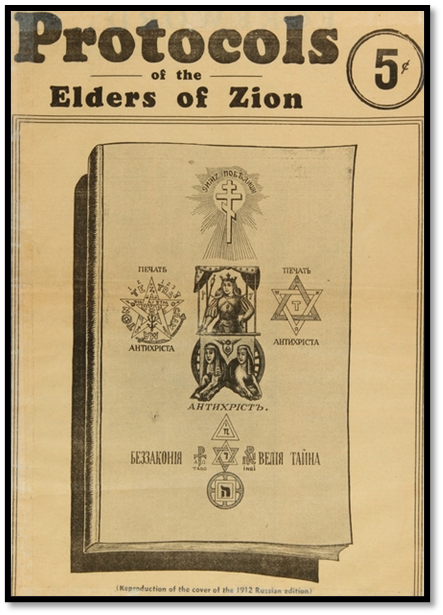
The Protocols: What is actually in it?
Updated: Apr 22, 2025
“Over the past hundred years, the Protocols of the Elders of Zion have been published in several dozen languages; their total circulation has most likely exceeded the works of Leo Tolstoy and Fyodor Dostoevsky. The ‘Protocols’ turned out to be Russia's largest contribution to world culture, so to speak”.[i]
- Yakov Kratov, Orthodox priest and scholar, 2003.
The ‘Lore’ of The Protocols
With all this discussion about a book you are probably thinking:
What is actually in it?
What makes it so bad or so convincing?

“The Protocols is not, purportedly, mere narration of a diabolical plot—it’s evidence of one”[ii]
This is a powerful factor and it explains the multitude of origin stories which shroud The Protocols in an air of mystery and intrigue: Sergei Nilus’ early 1905 edition claimed it recordings of the 1897 Zionist congress while newer editions changed this to the 1902 congress, other versions claim it was a Jewish congress held in 1869 in Leipzig[iii], another edition goes so far to claim The Protocols were written during the reign of King Solomon in Jerusalem in 929 BCE.[iv]
There are also multiple narratives on how The Protocols came to be recorded some versions claim it was recorded by hidden witnesses, or by a renegade Jew, another by disguised occultists and others Russian agents, some versions claim the recorder died to uncover the truth.
Over time more fantastical versions of where The Protocols came from appeared:
They were stolen from the Zionist leader Theodor Herzl’s home in Vienna.
Discovered by a governess in the home of a wealthy Jew.
A prominent journalist claimed he received it from ‘mysterious lady’ who said she found it in Paris.
A version later told in court in Geneva was that a senior official found it deep in the Swiss government archives.
Even owning a copy of the text becomes part of the lore which contributes to a conspiracy theorist becoming part of the narrative of their own conspiracy theory.[v]

One of the most enduring and tragic pieces of lore comes from real events: the murder of the Russian Royal family. After the 1917 revolution the Royal family was placed under house arrest and exiled to Yekaterinburg in the Urals. In July 1918, following the advances of the pro-Monarchist White Army the Bolsheviks executed the entire Royal Family and their entourage fearing that they could be recaptured. Weeks later when the Whites took over the location and investigated the murders, Nilus’ book was found among the possessions of the Tsaritsa Alexandra Feodorovna, this soon sparked rumours that the Royal Family was killed because they had a copy of the text and this fact used in propaganda as evidence that the Bolshevik’s were controlled by the Jews. It quite tragically ironic; the Tsaritsa was actually far less antisemitic than Tsar Alexander II and often remonstrated him on his antisemitic policies. Her journal indicates that she may have been reading The Protocols as a way to better argue against her husband and his antisemitism.
Theme, structure, and examples.
The truth is, as far as forbidden texts go it is really not that easy or an interesting read.
The book is written as a speech by an ‘Elder’ and so if you enjoy long diatribes on 19th century political talking points you might enjoy it, or you might agree with British historian Norman Cohn and author of Warrant for Genocide one of the most famous books on the history of The Protocols, who described the style as ‘turgid and diffuse, the argument torturous and illogical’[vi].
In terms of themes Cohn finds three overarching ones: “a critique of liberalism; an analysis of the methods by which world-domination is to be achieved by the Jews; and a description of the world-state which is to be established… the first two themes predominate the first nine ‘protocols’ while the remaining… are devoted mainly to a prophecy of the coming kingdom.”[vii]
So, what makes this ‘turgid’ text so appealing? Historian and critic Daniel Pipes suggests that the malleability of the content is one reason for its enduring popularity:
“The book's vagueness—almost no names, dates, or issues are specified—has been one key to this wide-ranging success….Its embrace of contradiction—that to advance, Jews use all tools available, including capitalism and communism, philo-Semitism[viii] and antisemitism, democracy, and tyranny—made it possible for The Protocols to reach out to all: rich and poor, Right and Left, Christian and Muslim, American and Japanese.”[ix]
Vagueness is a common element of conspiracy theory literature, the paratext of The Protocols (that is, the commentaries, introduction and chapter titles) allow the material to shift with contexts as new conspiracists can layer their own lens and political framework onto the document.

Another factor might be the perceptiveness of Maurice Joly whose satire ‘The Dialogue in Hell Between Machiavelli and Montesquieu’ makes up about two-fifths of The Protocols. [x] The book was a veiled critique of Napoleon III who had seized power in 1851 by coup d’etat upon failing to be re-elected as Prime Minister. But Joly was not only denouncing dictators behind the facade of Machiavelli who resides in hell in his book, but he was also critiquing the parliamentarian liberal establishment represented by Montesquieu and the overall modern bureaucratic capitalist state. Zipperstein writes that the book articulates the “susceptibility of liberal society to manipulation and distraction war, or greed, or the clouds of nostalgia”[xi]
Joly’s critiques remain timeless because the same form of state, a rational parliamentary capitalist system has existed across the world in both authoritarian and liberal countries from when he was alive until now. This system provided great wealth to a minority while leaving a majority discontent and excluded Joly taps into this sentiment. It can also be seen as a critique of a contradictory and inflammatory media system that is focused on dividing the working class through competing interests.
The Protocols and their themes
Protocol | Chapter title[xii] | Theme addressed[xiii] |
1 | The Basic Doctrine: "Right Lies in Might" | Freedom and Liberty; Authority and power; Gold=money |
2 | Economic War and Disorganization Lead to International Government | International Political economic conspiracy; Press/Media as tools |
3 | Methods of Conquest | Jewish people, arrogant and corrupt; Chosenness /Election; Public Service |
4 | The Destruction of Religion by Materialism | Business as Cold and Heartless; Gentiles as slaves |
5 | Despotism and Modern Progress | Jewish Ethics; Jewish People's Relationship to Larger Society |
6 | The Acquisition of Land, The Encouragement of Speculation | Ownership of land |
7 | A Prophecy of Worldwide War | Internal unrest and discord (vs. Court system) leading to war vs Shalom/Peace |
8 | The transitional Government | Criminal element |
9 | The All-Embracing Propaganda | Law; education; Freemasonry |
10 | Abolition of the Constitution; Rise of the Autocracy | Politics; Majority rule; Liberalism; Family |
11 | The Constitution of Autocracy and Universal Rule | Gentiles; Jewish political involvement; Freemasonry |
12 | The Kingdom of the Press and Control | Liberty; Press censorship; Publishing |
13 | Turning Public Thought from Essentials to Non-essentials | Gentiles; Business; Chosenness/Election; Press and censorship; Liberalism |
14 | The Destruction of Religion as a Prelude to the Rise of the Jewish God | Judaism; God; Gentiles; Liberty; Pornography |
15 | Utilization of Masonry: Heartless Suppression of Enemies | Gentiles; Freemasonry; Sages of Israel; Political power and authority; King of Israel |
16 | The Nullification of Education | Education |
17 | The Fate of Lawyers and the Clergy | Lawyers; Clergy; Christianity and non-Jewish Authorship |
18 | The Organization of Disorder | Evil; Speech |
19 | Mutual Understanding Between Ruler and People | Gossip; Martyrdom |
20 | The Financial Program and Construction | Taxes and Taxation; Loans; Bonds; Usury; Moneylending |
21 | Domestic Loans and Government | Stock Markets and Stock Exchanges |
22 | The Beneficence of Jewish Rule | Gold=Money; Chosenness/Election |
23 | The Inculcation of Obedience | Obedience to Authority; Slavery; Chosenness/Election |
24 | The Jewish Ruler | Kingship; Document as Fiction |
Comparison of Protocols to Joly’s Dialogues
The Protocols match the Dialogues in same sequence which suggest the translator (and plagiarist) copied the text in a mechanical fashion.
Some examples of plagiarised chapters from Joly’s dialogues[xiv]:
Sixth ‘Protocol’ | Joly’s Seventh Dialogue |
... Soon we will start organizing great monopolies – reservoirs of colossal wealth, in which even the large fortunes of the Gentiles will be involved to such an extent that they will sink together with the credit of their government the day after a political crisis takes place…..
We must use every possible kind of means to develop the popularity of our Supergovernment, holding it up as a protection and recompense of all who willingly submit to us. The aristocracy of the Gentiles, as a political power, is no more – therefore we need not consider it any more from that point of view. But as landowners they are still dangerous to us, because their independent existence is ensured through their resources. Therefore, it is essential for us, at all costs, to deprive the aristocracy of their lands. To attain this purpose the best method is to force up rates and taxes. These methods will keep the landed interests at their lowest possible ebb. ... At the same time we must give all possible protection to trade and commerce, and especially to speculation, the principal role of which is to act as a counterpoise to industry. Without speculation industry will enlarge private capitals. ...
| …I would organize huge financial monopolies, reservoirs of public wealth, in which all private fortunes would be so closely involved that they would sink together with the credit of the state the day after any political disaster.
As head of the government, all my edicts would be constantly directed to the same aim: to develop the preponderance of the state, out of all proportion, to make it the sovereign protector, promoter and recompenser ... Nowadays the aristocracy, as a political force, is no more; but the landowning bourgeoisie still constitutes an element of dangerous opposition to governments, because it is itself independent. It may be necessary to impoverish it or even to ruin it altogether. To achieve this it is only necessary to increase the rates and taxes on landed property, to keep agriculture in a state of relative inferiority, to give preferential treatment to trade and industry, and especially to speculation, for if industry prospers too much it can itself become dangerous, by creating too many independent fortunes.
|
Twelfth 'protocol' | Joly’s Twelfth dialogue |
Literature and journalism are the two most important educational powers; for this reason our government will buy up the greater number of periodicals. By these means we shall neutralize the bad influence of the private press and obtain an enormous influence over the human mind. If we were to allow them private periodicals we should ourselves start thirty, and so forth.
But the public must not have the slightest suspicion of these measures, therefore all periodicals published by us will seem to be of contradictory views and opinions, thus inspiring confidence and presenting an attractive appearance to our unsuspecting enemies, who will thus fall into our trap and will be disarmed. ...
These newspapers, like the Indian god Vishnu will be possessed of hundreds of hands, each of which will be feeling the pulse of varying public opinion.
If any chatterers are going to imagine that they are repeating the opinion of their party newspaper, they will in reality be repeating our own opinion, or the opinion which we desire. Thinking that they are following the organ of this party, they will in reality be following the flag which we will fly for them. | I foresee the possibility of neutralizing the press by means of the press itself. Since journalism is such a great force, my government will take to journalism. It will be journalism incarnate…
I will count the number of newspapers that represent what you call the opposition. If there are ten for the opposition, I shall have twenty for the government; if there are 20 I shall have 40; if there are 40 I shall have 80. ... But the mass of the public must have no suspicion of these tactics…
Like the god Vishnu, my press will have a hundred arms, and these arms will give expression to all shades of opinion throughout the whole country. People will belong to my party without realizing it. Those who think they are talking their own language will be talking mine, those who think they are stirring up people on their side will be stirring up people on mine, those who think they are marching under their flag will be marching under mine. ...
|
Last is an extract from the ‘Third Protocol’ which does not contain Joly’s work. I have included this passage as it demonstrates the ‘embrace of contradiction’ that Pipes described.
Third Protocol “We intend to appear as though we were the liberators of the labouring man, come to free him from this oppression, when we shall suggest to him to join the ranks of our armies of Socialists, Anarchists, and Communists. The latter we always patronize, pretending to help them out of fraternal principle and the general interest of humanity evoked by our socialistic masonry. The aristocracy, who by right shared the labour of the working classes, were interested in the same being well-fed, healthy, and strong. We are interested in the opposite, i.e. in the degeneration of the Gentiles. Our strength lies in keeping the working man in perpetual want and impotence; because, by so doing, we retain him subject to our will and, in his own surroundings, he will never find either power or energy to stand up against us. Hunger will confer upon Capital more powerful rights over the labourer than ever the lawful power of the sovereign could confer upon the aristocracy. We govern the masses by making use of feelings of jealousy and hatred kindled by oppression and need. And by means of these feelings we brush aside those who impede us in our course.When the time comes for our Worldly Ruler to be crowned, we will see to it that by the same means—that is to say, by making use of the mob—we will destroy everything that may prove an obstacle in our way.”[xv]
|
Sources:
[i] Yakov Kratov. Centenary of the First Publication of the So-Called 'Protocols of the Elders of Zion. Radio Svoboda, September 14, 2003. Accessed May 13, 2024. https://www.svoboda.org/a/24196190.html
[ii] Steven Zipperstein. The Conspiracy Theory to Rule Them All. The Atlantic, August 25, 2020 https://www.theatlantic.com/politics/archive/2020/08/conspiracy-theory-rule-them-all/615550/
[iii] These are all farcical given that these events were highly covered at the time. The 1897 congress had 26 journalists in attendance, it would not be the best time to have a secret meeting on world domination. The various claims come from the research by
Norman Cohn. Warrant for genocide: The myth of the Jewish world-conspiracy and the Protocols of the elders of the Zion. (Harper and Rowe, 1969) p.50
[iv] Michael Hagemeister. The Protocols of the Elders of Zion: Between History and Fiction New German Critique , Winter, 2008, No. 103 In: Dark Powers: Conspiracies and Conspiracy Theory in History and Literature (Winter, 2008), pp. 83-95. P.89.
[v] I even got caught by this during my research. The first version I found claimed you could be sentenced to death if found with a copy- until I realised it was referring to holding a copy in the Soviet Union which has been gone for almost 30 years!
[vi] Cohn. Warrant for genocide. P.61
[vii] Ibid p.61
[viii] Meaning love of admiration of Jews.
[ix] Daniel Pipes. Conspiracy: How the Paranoid Style Flourishes and Where It Comes From. The Free Press, Simon & Schuster 1997.P. 155
[x] Cohn. Warrant for genocide. p 75
[xi] Steven Zipperstein. The Conspiracy Theory to Rule Them All.
[xii] Some versions do not have chapter titles, this is taken from the Victor Marsden translation.
[xiii] This breakdown comes from Steven L Jacobs & Mark Weitzman. Dismantling the Big Lie:The Protocols of the Elders of Zion. Simon Wiesenthal Center In Association With Ktav Publishing House 2003 pp.21-23
[xiv] Ibid
[xv] Ibid