Jews and Revolution: Weren't the Bolshevik's all Jewish?
“This mystic and mysterious race has been chose for the supreme manifestation, both of the divine and the diabolical….[Jews have been] the mainspring of every subversive movement during the nineteenth century”-
Winston Churchill[i]
The Russian Civil War and following defeat of the reactionary Whites saw the repeated emphasis on the involvement of Jews in revolutionary and communist movements- later in the 1930s the German Nazi party used the term 'Judeo-Bolshevism' to describe this- equating any communist movement as really a Jewish ploy.
There was undoubtedly an exaggeration of the Jews role in the revolution but as historian Albert Lindemann notes there was some truthfulness to the claim which is what fed this belief although it depends on how we define a Jew and what type of Jew they were.
The belief stems largely from the role of European Jews in the Socialist movement, despite making up only 2% of Europe, prominent Jews such as Karl Marx, Moses Hess and Rosa Luxembourg were important for early socialist thinking.
In 1905 Vladimir Lenin noted during a speech in Zurich: “the Jews furnished a particularly high percentage… of leaders of the revolutionary movement”[ii]
Maxim Gorky was said to have once commented that “an intelligent Russian is almost always a Jew or someone with Jewish blood in his veins”.[iii]
The high degree of Jewish leadership in the Revolutionary movement may be explained by the backgrounds of these leaders, almost all were Russian speakers, from middle- or upper-class backgrounds and atheists who actively rejected Jewish traditions/beliefs.

This can be contrasted to more active Jews, those situated in the Pale of Settlement (an area that was the designated location for Jews in the Russian Empire, approximately where Ukraine and Poland are located) who were by and large conservative, involved in industries typically targeted by socialists such as trade and commerce. One prominent Ukrainian Jewish lawyer noted that many Jews were by and large anti-Bolshevik and made up a much larger percentage than those in the Bolshevik government.[iv]
As the Russian Civil War commenced, Jews were dragged into the conflict unwillingly. For many Jews they likely felt the departure of the antisemitic Tsarist government with little remorse, and to their credit the Bolshevik provided equal rights to Jewish subjects. Nonetheless the Civil War was a horrendous time for Jews, many whom became the victims of the horrific pogroms and slaughter enacted by each side.
A note has to also be made regarding the number of Jews in competing socialist movements such as the Mensheviks, the main opponents to the Bolsheviks. They had such a large number of Jews that a young Joseph Stalin joked in 1903 that the Bolshevik’s ought to organise a ‘pogrom within the party’[v], the joke was not taken well[vi]
Despite the small role of Jews in the broader movement, as Lindemann notes, the visibility of key members of the Bolshevik movement and the terrifying arm of the movement, the dreaded Cheka made actual discussion of numbers of Jews and percentages compared to Gentiles moot. Even naming top leaders can be a subjective task but he notes that in the first twenty years of the Bolshevik government ten to twenty leaders were Jewish. Of the seven ‘major’ figures of the Russian revolution listed in Makers of the Russian revolution, four were Jewish while in the list of the remaining fifty, one-third are Jewish. [vii] The most prominent early Jewish members were Leon Trotsky to whom vicious antisemitic propaganda was made. Some other prominent figures were:
Grigori Zinoviev- president of the Communist International and Chairman of the Petrograd Soviet.
Lev Kamenev- who headed the party newspaper Pravda and member of the Central Committee in 1917.
Adolf Yoffe who served in the Central Committee in 1917 as well as chair of the Revolutionary Military Committee of the Petrograd Soviet, Yoffe later headed the Soviet diplomatic delegation to negotiate the Brest-Litovsk Treaty- the ceasefire with Germany in WWI.
Yakov Sverdlov who served as secretary and main organiser of the Bolsheviks in 1917-18 and later head of state.
Genrikh Yagoda, who rose through the ranks of the Cheka in the early years to then take the helm of the NKVD in the mid-1930s (as well as founding the Russian poison laboratory see Chapter 2) and assisted in arresting and executing Old Guard revolutionaries in particular Grigori Zinoviev and Lev Kamenev in Stalin’s well-known Purges.
Moisei Uritsky, chief of the Cheka in Petrograd, where the Red Terror was most pronounced (which resulted in the mass arrest, torture and execution of ‘counterrevolutionaries’ with some estimates at a minimum of 300,000[viii]).


Reactionaries would also point to non-Jewish folk who had the slightest involvement with Jews as part of this ‘Judeo-Bolshevik’ plot. Vladimir Lenin whose grandfather on his mother’s side was revealed to be a Jew was often trotted out as proof of a Judeo-Bolshevist conspiracy (Russian nationalist papers of the late 1990s revealed his ties). Another non-Jew was Felix Dzerzhinsky head of the Cheka, in his youth he had learned Yiddish, had Jewish friend and had several romances with Jews enough for reactionaries to label him ‘jewified’.
The Cheka itself contained a high proportion of Jewish members, the highest proportion being in Kiev of which 75% of its branch containing Jews, extraordinary considering they comprised of 1% of the population of Kiev this branch was later ordered to limit Jews in top positions.[ix] There seems to be a few reasons for the high proportion, historian George Leggett believes that it was a conscious policy to employ non-Russian minorities as they were less likely to sympathise with the local population while Lindemann suggests that the large majority of Jewish socialists and their educated backgrounds lent them towards intelligence work (and the Okhrana often employed Jews as double agents, there were many instances of ex-Okhrana working for the Cheka). [x]
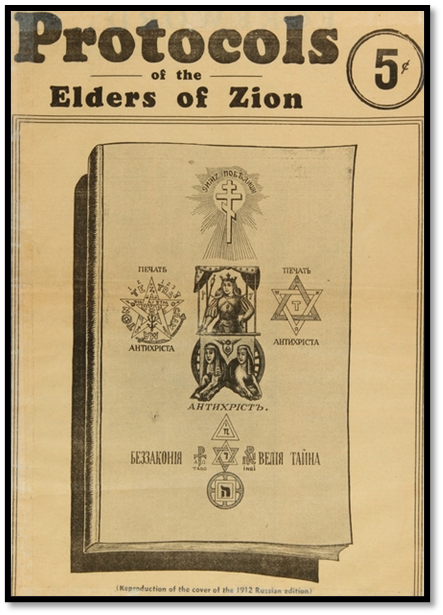
The widespread popularity or interest in The Protocols in the 1920s should then be seen context of the First Red Scare that swept across Europe and the U.S stoked by the Russian revolution victory but also anarchist violence, labour unrest and the White émigré Russians who had fled the Soviet Union. In the US it justified mass arrests and deportations of radical Russians (most famously Emma Goldman and Alexander Berkman) by the police and was the beginning of the FBI, ran by a young twenty-four-year-old named J. Edgar Hoover.
[i] As quoted in: Albert Lindemann Esau’s Tears : Modern Anti-Semitism and the Rise of the Jews, 1870-1933. 2001. Cambridge University Press. P. 423 Ibid. P. 425
[ii] ibid
[iii] Ibid. P. 425
[iv] Ibid. P. 428, Stalin was very antisemitic, his Doctor’s plot in 1952 was likely a pretext for massive deportation of Jews before he died.
[v]And this signposts the antisemitism that Stalin held, the 1950s 'Doctors Plot' saw him use antisemitic tropes to begin purging Jews from prominent positions in Soviet society- if Stalin had not died in the midst of this plot some historians believe he may have begun a campaign of ethnic cleansing against Jews.
[vi] Ibid. P. 430
[vii]George Leggett. The Cheka: Lenin’s Political Police ; the All-Russian Extraordinary Commission for Combating Counter-Revolution and Sabotage (Dec. 1917 to Feb. 1922). 1986. Oxford: Clarendon. P. 360.
[viii] And were ordered to execute for propaganda reasons token Jewish individuals, before the decree there had only been 1 execution of a Jew by the Kiev. George Leggett. The Cheka: P. 262 and 413
[ix] Albert Lindemann Esau’s Tears. P. 443
[x] As quoted in: Albert Lindemann Esau’s Tears : Modern Anti-Semitism and the Rise of the Jews, 1870-1933. 2001. Cambridge University Press. P. 423